Choosing a Payoneer alternative for client payments
Compare payment routes around your customers, currencies and bookkeeping needs, rather than choosing on a headline transfer fee alone.
By the Novaveliq team
The useful bit
The right alternative depends on how a customer pays and where you need the funds to end up. Compare the whole journey, not just one advertised rate.
Start with the job you need the service to do
A freelancer receiving a platform payout has a different problem from an agency billing its own clients. Before replacing Payoneer, write down how money reaches you today: a marketplace withdrawal, a customer's card payment, an international bank transfer or another route. Check whether the platform or customer can actually use the replacement you are considering.
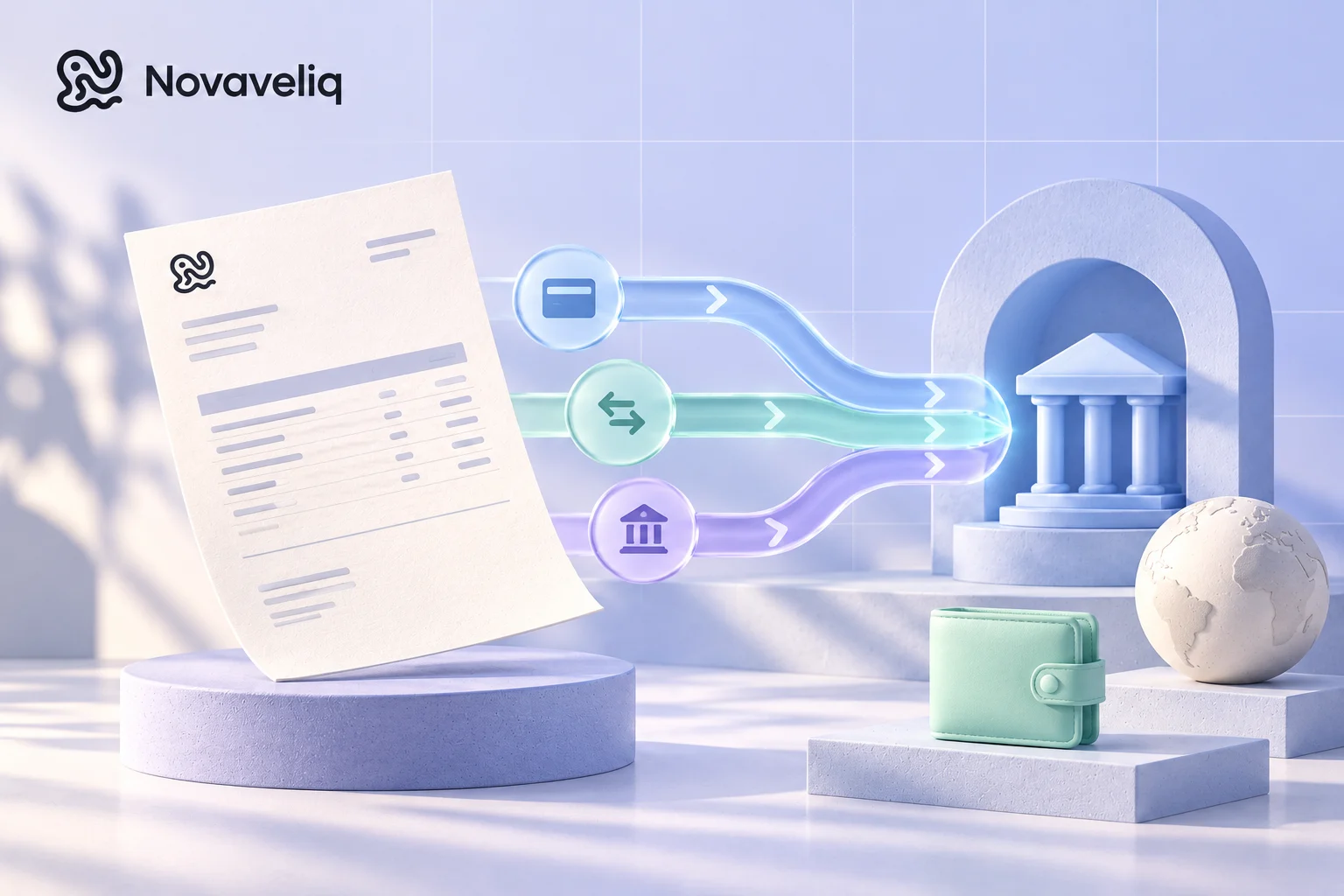
Then separate three jobs: issuing the invoice, accepting the customer's payment and moving the balance into your business bank account. One service may handle several jobs, but an invoicing workspace is not automatically a bank account or an international money-transfer service. Replacing the wrong part can leave your real bottleneck unchanged.
Consider bank-transfer routes for customers who already pay invoices
A business bank transfer may be sufficient when your client can pay in the currency you invoice and both sides can use the relevant banking network. Ask your bank about incoming-payment charges, exchange rates and any intermediary charges. A familiar bank account can still be expensive for the wrong cross-border route.
Wise Business, Revolut Business and Airwallex are other providers worth investigating for supported business payment and currency workflows. Their products, account details, eligibility and charges vary by market and account type. Check the exact receiving and withdrawal route you intend to use; do not assume an account detail offered in one country is available to your business in another.
Consider card or wallet routes when customer convenience matters
PayPal may be worth considering when your customers already use its payment experience. Stripe may be relevant when you want supported card-payment or checkout tools in your invoicing process. Neither choice should be made solely because a customer recognises the logo: check business eligibility, payment-method availability, settlement currency and how you will handle a disputed payment.
An invoice tool can organise the bill while a connected processor accepts the payment. Confirm which service supplies the actual payment link and which account receives the proceeds. Novaveliq helps organise invoices and available payment instructions; it should not be treated as a replacement for every receiving account or payout feature of a dedicated provider.
Price one real example from beginning to end
Choose a typical invoice amount, the customer's country and the currency you want to keep. Compare receiving charges, processing fees, exchange-rate conversion, withdrawal charges and any subscription cost. If a route involves two conversions, include both. A low collection fee can be outweighed by the cost of moving the balance afterwards.
Also compare the records each route gives you. You need to distinguish the customer's gross payment, fees, refunds and final bank receipt. A service that saves a little on processing but leaves a difficult monthly reconciliation may not be the cheaper choice for your business overall.
- Can this customer or platform use the payment route?
- Can your business receive and retain the required currency?
- What is the total cost at your actual invoice size?
- What evidence and support are available if something goes wrong?
- How will the invoice, provider payment and bank receipt be matched?
Move one payment route before moving everything
Confirm the new account and its business eligibility before changing invoice instructions. For a suitable first transaction, check the customer's payment experience and the final receipt, then review the fee and currency records. Update saved templates only when the new route is ready to use.
Keep old balances, outstanding invoices and any potential refunds or disputes in view while switching. Tell customers clearly which instructions apply to each invoice. The names here are a research shortlist, not a live ranking or a claim that any provider is universally cheapest. Review current official pricing and terms for your own business before deciding.
Further reading
 Novaveliq
Less paperwork. More room to build.
Keep your invoices, contacts and payment instructions organised in Novaveliq.
Create your workspace